.png)
.png)
.png)
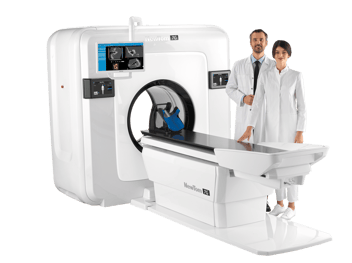
The evolution of volumetric diagnostics has reached a new milestone of excellence.
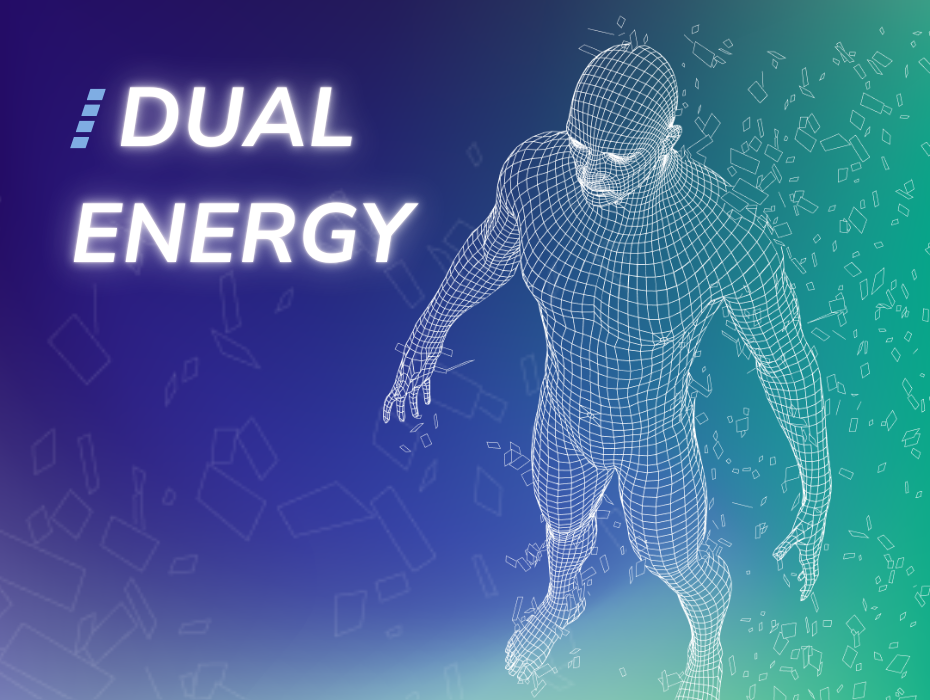
Now that the Newtom 7G integrates Dual Energy (DE) technology, Cone Beam CT has evolved from simple morphological analysis to true tissue characterisation.
Unlike traditional single-energy scans, the Newtom 7G uses two different radiation emissions to acquire two sets of data from the same anatomical region, ensuring enhanced results and unprecedented diagnostic accuracy.
Enhanced tissue contrast and BME analysis
The core of Dual Energy technology lies in its ability to distinguish materials based on their atomic response to different energy levels. This translates into improved tissue contrast, a crucial advantage for visualising soft tissue structures, which appear with superior definition compared to standard CBCT.
This technology also allows for greater clarity in the architecture of trabecular and cortical bones, enabling extremely accurate microstructural assessment. In this context, the Newtom 7G enables BME (Bone Marrow Evaluation): an advanced analysis of bone marrow that provides distinctive clinical data for the assessment of inflammatory or degenerative diseases. Through this approach, clinicians obtain valuable information regarding the chemical composition of tissues, significantly improving the quality of diagnostic analysis without resorting to outdated terminology.
Colour-Coded Images and reduction of artifacts
Using dedicated software, the Newtom 7G transforms complex data into immediate and intuitive visual information. Through VMI (Virtual Monochromatic Images), the system simulates different energy levels (KeV) to optimise contrast and ensure superior reduction of metal artifacts. Compared to traditional volumetric technologies, Dual Energy drastically reduces distortions generated by metallic structures, allowing for extremely clear visualisation of the interfaces between bone and implants.
The integration of colour-coded images and VNCa (Virtual Non-Calcium) maps also allows tissue segmentation and differentiation of materials within the scanned area. This means that clinicians can quickly distinguish between different components during dynamic visualisation, making the decision-making process faster and more reliable.
Toward a new diagnostic standard
The Newtom 7G with Dual Energy technology represents a paradigm shift in radiological imaging. Choosing this system means offering patients superior accuracy and clinicians a tool that simplifies the understanding of complex cases.
With improved contrast resolution and greater HU value precision, Newtom 7G remains the benchmark for those who refuse to compromise between image quality and clinical safety.
.png?width=352&name=Newtom%20%20immagini%20blog%20(3).png)